


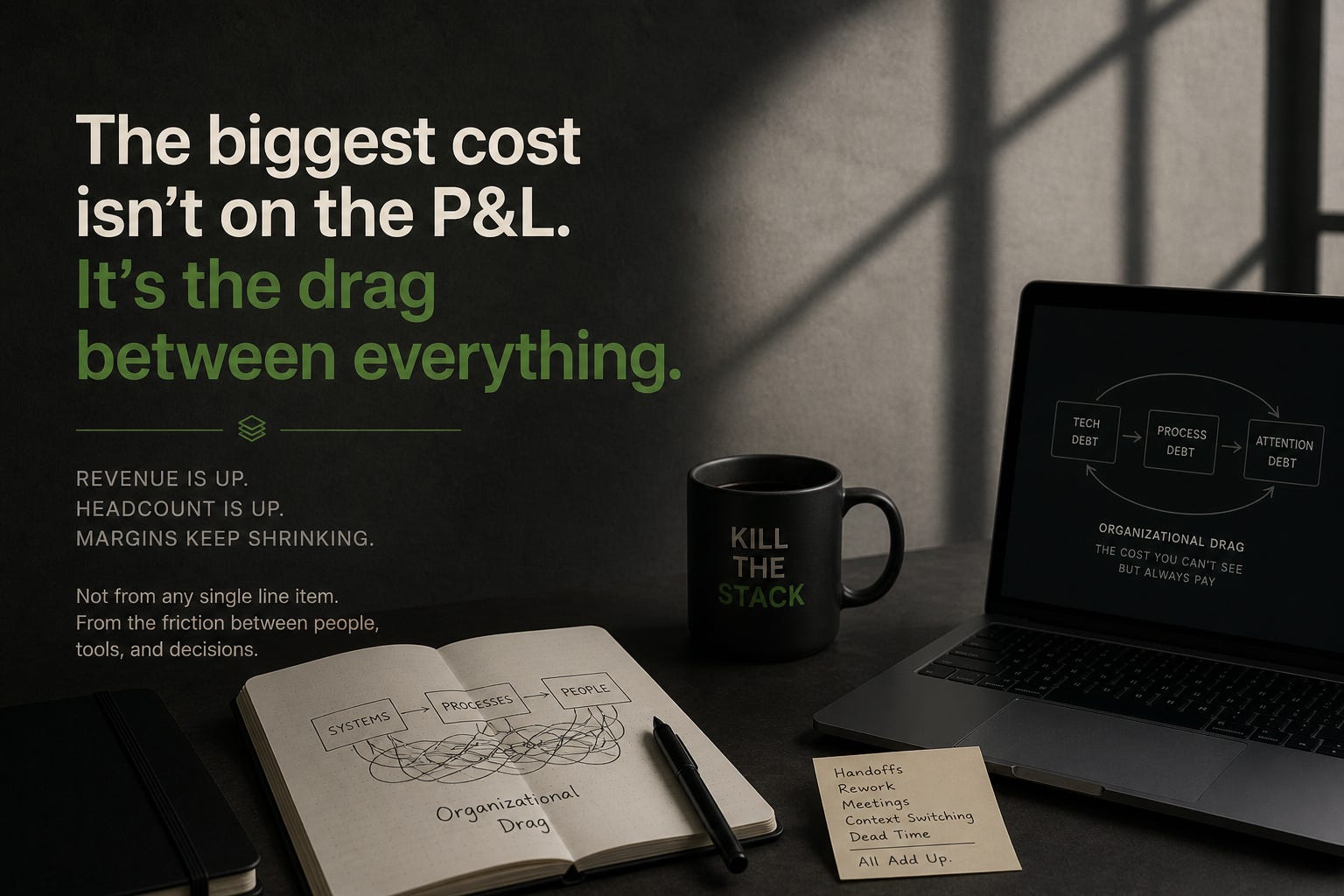
Last month, I reviewed our quarterly numbers. Revenue was up. Headcount was up. But our margins kept shrinking, not by a lot at once, but steadily, like a slow leak you can hear but can’t find.
So I traced the bleed. Not to any single cost center. Not to a bad hire or a bloated tool budget. The cost was hiding in the gaps between things. In the handoffs that took two days because two systems didn’t talk to each other. In the status meetings that existed because no dashboard surfaced the information automatically. In the hours my ops team spent re-keying data that already existed somewhere else in the stack, just in the wrong format.
The most significant expense in my company was not listed on any line item. It was the friction between people, tools, and decisions — the drag that doesn’t show up in any report but determines whether a company scales or stalls.
I call it organizational drag. And if you’re running a company right now, it’s almost certainly the biggest cost you’re not measuring.
Engineers have a term for one version of this: technical debt. Ward Cunningham coined the metaphor in 1992 to describe what happens when you ship code that works but isn’t clean — you’ve borrowed against the future, and eventually you have to pay it back with interest.
What started as a metaphor became a line item. McKinsey estimates that 20 to 40 percent of the value of a company’s entire technology estate is consumed by tech debt. Other studies put it worse — 40 to 50 percent of development time goes to unplanned rework, bug fixes, and maintenance on systems that should have been rebuilt years ago.
Tech debt is the most visible form of invisible cost, because engineers have language for it. They can point at a codebase and say: this is broken, this is the cost, this is what it would take to fix.
But tech debt is just the version that got a name. The same pattern runs much deeper.
Every company carries what I think of as process debt — the accumulated weight of workflows that were never designed, just inherited.
The approval chain that requires three signatures because someone made a bad call in 2019 and the response was to add a checkpoint instead of fixing the decision-making. The weekly report that nobody reads but everyone fills out because no one remembers who asked for it. The onboarding flow that routes through four departments because the original one was designed when the company had twelve people and it just… grew.
Ronald Coase won a Nobel Prize for a deceptively simple insight. In his 1937 paper “The Nature of the Firm,” he argued that companies exist because markets have transaction costs — the friction of finding, negotiating, and enforcing every exchange. Firms reduce that friction by bringing coordination inside.
But here’s what Coase’s insight implies and most operators miss: firms themselves accumulate internal transaction costs over time. Every workaround. Every undocumented approval. Every process that exists because removing it would require understanding why it was created, and nobody has time for that archaeology.
Process debt is invisible because it looks like work. People are busy. Tasks are moving. The system appears functional. But underneath, a significant percentage of that activity is just friction — the organizational equivalent of spinning wheels on ice.
Nobody audits this. No one walks through the company and asks: how much of what we do today exists because it was the right thing to do, and how much exists because it was easier to add a step than to fix the system?
The third layer is the most expensive and the hardest to see: attention debt.
Cal Newport, in A World Without Email, describes what he calls the “hyperactive hive mind” — the default operating mode of most knowledge companies, where coordination happens through constant, unstructured, back-and-forth messaging. Slack threads, email chains, quick syncs, “got a minute?” interruptions. It feels like work. It feels productive. It is, in most cases, the single biggest drain on the only resource that actually generates value in a knowledge company: focused human attention.
The math is brutal. Every context switch carries a cognitive recovery cost. Your brain doesn’t toggle between tasks — it drags residue from the last one into the next. The more unresolved threads you’re carrying, the worse the drag gets. Newport calls this the “attention capital” problem: the raw material of knowledge work is human cognition, and most organizations treat it as if it were infinite and free.
It isn’t. Every status meeting could have been a dashboard. Every approval chain that pulls someone out of deep work. Every Slack ping resets a train of thought. These aren’t minor interruptions. They’re withdrawals from a finite account, and most companies are overdrawn by Tuesday.
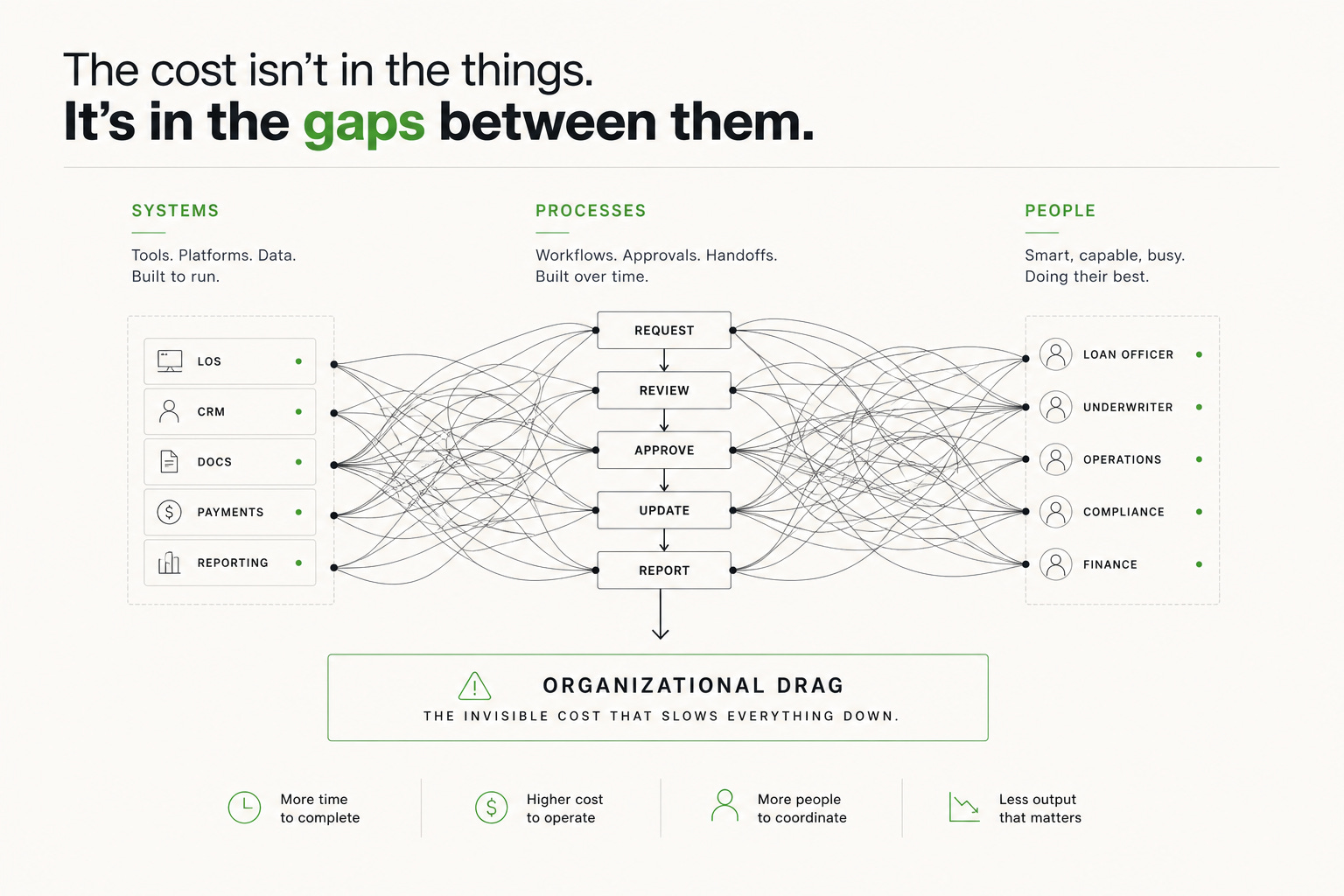
Here’s what makes organizational drag so dangerous: these three debts don’t just coexist. They compound.
Tech debt creates workarounds. Those workarounds become process debt — undocumented, unquestioned, just the way things are done. Process debt requires coordination to manage, because when systems don’t flow, humans have to step in and push. That coordination becomes meetings, check-ins, status updates — attention debt. And attention debt means nobody has the unbroken time to step back, diagnose the underlying systems, and fix them. Which generates more tech debt.
The spiral is self-reinforcing. And because each layer is invisible on its own, the compounding effect is nearly impossible to see from the inside. What you see is the symptom: things feel slow. Headcount keeps growing but output doesn’t scale proportionally. Margins thin and nobody can point to a single cause.
The cause isn’t single. It’s systemic. It’s the drag between everything.
I’ve started running a different kind of audit. Not financial — operational. For every recurring process, meeting, and workflow, I ask three questions. What is this compensating for? What would make it unnecessary? And can we replace it with AI?
The answers are uncomfortable. Most of the time, the thing that would make the process unnecessary is a system that should have been built two years ago but wasn’t, because everyone was too busy running the workaround.
That’s the trap. The drag consumes the very capacity you’d need to eliminate it.
Breaking the cycle requires treating invisible costs with the same rigor you’d apply to visible ones. Measure handoff time, not just task time. Track rework rates. Count the meetings that exist because a system doesn’t. Put a number on the context switches your team absorbs in a week and do the math on what that costs in lost output.
You can’t cut what you can’t see. And right now, the most expensive thing in your company is almost certainly something you’ve never measured.
The question isn’t “where is the money going?”
It’s “where is the time going?”
And the answer, in almost every company I’ve seen, is the same: into the space between your systems, your processes, and your people’s attention. Into the drag.
Stop optimizing the visible costs. Start measuring the invisible ones.
Chris Grimes is the founder of FundMore, an AI-native loan origination platform. FundMore builds agentic mortgage and lending infrastructure for institutional clients across Canada and the US.